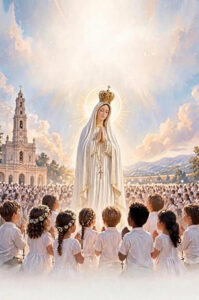
Un milione di bambini pregano il Rosario – 7 ottobre 2026
Tutte le news dell’Armata Bianca

Thus begin Lucia’s “Memoirs”:
“I have been aware of my actions since I was in my mother’s arms. I remember being rocked to sleep to the sound of various songs. The first thing I learned was the Hail Mary, because my mother used to hold me in her arms while teaching catechism to my sister Carolina, who was five years older than me.
When I turned six, my mother thought I was ready to receive my First Communion. My joy was beyond words. Finally, the appointed day arrived. When the priest came to distribute the Bread of Angels, it felt as if my heart would leap out of my chest. But as soon as the Divine Host rested on my tongue, I felt an unshakable peace and serenity, an atmosphere so supernatural that the presence of our Good Lord became as perceptible to me as if I could see and hear Him with my bodily senses. Then I made my petitions: ‘Lord! Make me a saint, keep my heart always pure, just for You.’ At that moment, it seemed that the Good Lord spoke clearly in the depths of my soul: ‘The grace granted to you today will remain alive in your soul, producing fruits of eternal life.’
I felt so filled with the Bread of Angels that for a while I could eat nothing else. From that moment, I lost all pleasure and attraction for worldly things, and I only felt truly at peace when alone in some solitary place, where I could recall the delights of my First Communion.
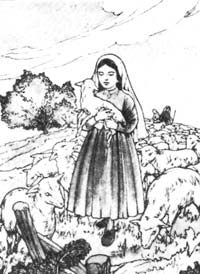
Before the events of 1917, aside from the family ties between us, I had no particular affection that made me prefer the company of Jacinta and Francisco over that of other children. I don’t know why, but Jacinta and her little brother Francisco had a special fondness for me. They almost always sought me out to play. They didn’t enjoy being with other children, and they would ask me to go with them near a well that my parents had at the bottom of our garden. Once there, Jacinta would choose the games we played.
After dinner, my mother often told us stories: the Passion of Christ, the life of Saint John the Baptist, the apparitions of Lourdes. So I knew the Passion of the Lord as a sort of fairy tale, and I began telling it in detail to my cousins, calling it ‘the story of the Lord.’ Listening to the sufferings of Our Lord, Jacinta was moved to tears. Many times afterward, she would ask me to tell it again. She cried sorrowfully and would say: ‘Poor Our Lord. I’ll never commit any sin. I don’t want Our Lord to suffer more.’
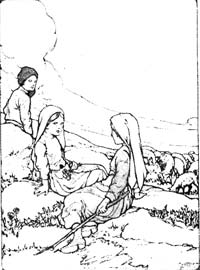
Meanwhile, I had reached the age at which my mother would send her children to watch over the flock. My sister Carolina was twelve and needed to start working. That’s why my mother entrusted me with our flock. Though still very young, my aunt entrusted her sheep to Francisco and Jacinta. I remember how they came to me bursting with joy to tell me the news and to make plans to gather our flocks together each day. We decided that each one would set out at the time appointed by their mother, and whoever arrived first would wait for the others at the ‘Borreiro’—that’s what we called a small pond located in a low area of the hill. Once gathered, we would choose the pasture for the day and head there, happy as if we were going to a party.
We gained the sheep’s trust by feeding them parts of our lunches, and so, when we reached the pasture, we could play without worry, knowing the sheep wouldn’t wander far. Jacinta loved picking up the little white lambs, sitting with them on her lap, stroking them, and carrying them home in her arms so they wouldn’t get tired. One day, walking home, she placed herself in the middle of the flock. ‘Jacinta,’ I asked, ‘why are you walking in the middle of the sheep?’ She replied, ‘It’s to be like Our Lord, who on this picture I was given is in the middle of many sheep and carries one in His arms.’
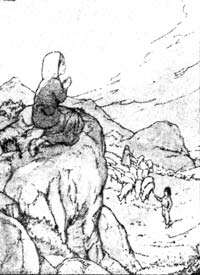
Jacinta loved hearing the echo in the valley. One of our favorite amusements was to sit on the highest rocks atop the hills and shout out words. The name that echoed best was MARY. Sometimes Jacinta would recite the entire Hail Mary, waiting to say each word until the previous one had stopped echoing.
We also loved singing. Though we unfortunately knew many secular songs, Jacinta preferred hymns like Hail, Noble Lady, Pure Virgin, and Angels, Sing with Me. As we walked through the hills, what Francisco liked most was to sit on the highest rock and play the flute or sing. If Jacinta and I ran down the slopes, he would stay behind, absorbed in his music.
Jacinta loved to go out at dusk to a threshing floor in front of our house to watch the sunset and the starry sky. She was captivated by bright moonlit nights. We used to compete to see who could count more stars, which we said were the lanterns of the angels. The moon belonged to Our Lady, and the sun to Our Lord. Jacinta would sometimes say: ‘I love Our Lady’s lantern more because it doesn’t burn or blind us like Our Lord’s.’ Francisco would join us there, and while we waited for Our Lady and the Angels to light their lanterns, he too would delight in counting stars. But nothing enchanted him more than a beautiful dawn or sunset. As long as there was a ray of sunlight left, he didn’t care about the stars. ‘No star is as beautiful as Our Lord’s,’ he would say to Jacinta, who preferred Our Lady’s because it didn’t hurt the eyes. Francisco would gaze at the sun’s rays reflecting off windows or water drops on trees and bushes, making them sparkle like other stars—far more beautiful, in his eyes, than those of the angels. When there was no moonlight, we would say Our Lady’s lamp had run out of oil.
One beautiful day, we were with our sheep on a property my parents owned on the hill called Cabeço. Around noon, a gentle drizzle fell, lighter than dew. We crossed the hill, followed by our sheep, in search of a rock for shelter. We spent the day there, even though the rain stopped and the sun came out bright and clear. We ate our lunch and prayed the Rosary. Afterward, we played with small stones. A while into our game, a strong wind began shaking the trees, making us look up, since the weather had been so calm. Then we saw, coming toward us through the olive trees, a boy of about 14 or 15, whiter than snow, and radiant like crystal in the sunlight. He was very beautiful. As he reached us, he said: ‘Do not be afraid. I am the Angel of Peace. Pray with me!’ Kneeling, he bowed his forehead to the ground and made us repeat three times: ‘My God, I believe, I adore, I hope, and I love You. I ask pardon for those who do not believe, do not adore, do not hope, and do not love You.’ Then he rose and said: ‘Pray this way. The Hearts of Jesus and Mary are attentive to the voice of your supplications.’ His words engraved themselves so deeply in our minds that we never forgot them.
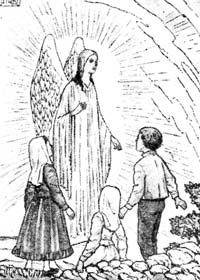
Later, one summer day, after our midday rest at home, we were playing near a well in our garden that we called Arneiro… Suddenly, we saw the same image—or angel, at least it seemed to be the same—who said: ‘What are you doing? Pray! Pray a great deal! The Sacred Hearts of Jesus and Mary have designs of mercy for you. Offer prayers and sacrifices constantly to the Most High.’
‘How are we to make sacrifices?’ I asked. ‘Offer God everything you can as a sacrifice, in an act of reparation for the sins by which He is offended and in supplication for the conversion of sinners. In this way, you will draw peace upon your country. I am its Guardian Angel, the Angel of Portugal. Above all, accept and bear with submission the suffering the Lord will send you.’ Before disappearing, the Angel clarified his invitation to penance and little offerings: ‘The little sacrifices of children are dear to the Lord: they are powerful for the conversion of sinners.’
These words of the Angel became like a light that helped us understand who God is, how much He loves us and wants to be loved, the value of sacrifice, how pleasing it is to Him, and how He uses it to convert sinners. From that moment on, we began to offer God everything that mortified us, without seeking out further penances, except to spend hours prostrate on the ground, repeating the Angel’s prayers.”
During the second apparition of the Angel, after the first moments had passed, Francisco asked me:
“You spoke with the Angel—what did he say to you?”
“Didn’t you hear it?”
“No. I saw that he was speaking with you; I heard what you said to him, but I didn’t hear what he said to you.”
So I told him everything the Angel had said in the first and second apparitions.
A good amount of time went by. One day, we took our flocks to graze on a property of my parents, an olive grove we called Pregueira, located on the slopes of Mount Cabeço, already mentioned, just above Valinhos. After having our snack, we agreed to go pray in the grotto on the other side of the hill. As soon as we arrived, we knelt down with our foreheads to the ground and began repeating the Angel’s prayer:
“My God, I believe, I adore, I hope, and I love You…”
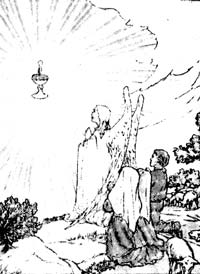
I don’t know how many times we had repeated this prayer when we noticed a strange light shining upon us. Lifting our heads to see what was happening, we saw the Angel. He held a chalice in his left hand, and above it hovered a Host, from which drops of Blood were falling into the chalice.
The Angel left the chalice suspended in the air, knelt beside us, and made us repeat three times:
“Most Holy Trinity, Father, Son, and Holy Spirit, I adore You profoundly, and I offer You the Most Precious Body, Blood, Soul, and Divinity of Jesus Christ, present in all the tabernacles of the world, in reparation for the outrages, sacrileges, and indifference by which He is offended. And by the infinite merits of His Most Sacred Heart and the Immaculate Heart of Mary, I beg the conversion of poor sinners.”
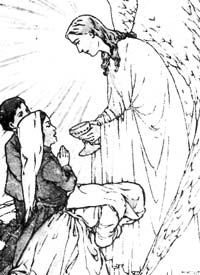
After repeating this prayer three times, the Angel rose, took the chalice and the Host, and gave me the consecrated Host. He gave the contents of the chalice to Jacinta and Francisco, saying at the same time:
“Take and drink the Body and Blood of Jesus Christ, terribly outraged by ungrateful men. Make reparation for their crimes and console your God.”
Then, bowing down to the ground once again, he repeated the same prayer with us three more times:
“Most Holy Trinity…” and then disappeared.
We remained in the same position for a long time, repeating the same words. When we finally got up, we saw that night had fallen, and it was time to go home.
In the days that followed, the presence of God was so intense within us that it nearly overwhelmed us completely. For a long time, it seemed to take away even the use of our senses… The peace and joy we felt were immense, but entirely interior—the soul completely absorbed in God. The physical weakness that overtook us was also profound.
When, after several days, we returned to our normal state, Francisco asked:
“The Angel gave you Holy Communion, but what did he give to me and Jacinta?”
“He gave us Holy Communion too,” Jacinta answered, with indescribable joy.
“Didn’t you see that it was the Blood falling from the Host?”
“I felt that God was within me, but I didn’t know how!” Francisco said.
Little by little, that atmosphere faded, and we returned to playing with nearly the same energy and freedom as before.
On May 13, 1917, I was playing with Jacinta and Francisco on the top of the hill at Cova da Iria (the very place where the Basilica now stands); we were amusing ourselves by building a small wall around a bush, when suddenly we saw something like a flash of lightning.
I said to my cousins:
“We’d better go home; there’s lightning, and it might storm.”
“Yes, let’s go,” they replied.
We began to descend the slope, driving our sheep toward the road. When we had gone about halfway down the hill, just beyond a large holm oak, we saw a flash of lightning again. After taking a few more steps, we saw on top of a small holm oak a Lady all dressed in white, shining more brightly than the sun. She radiated a light clearer and more intense than a crystal glass filled with water illuminated by the burning rays of the sun.
We stopped in surprise. We were so close to her that we were inside the light she radiated—or that surrounded her. We must have been about a meter and a half away. Then the Lady spoke to us:
“Do not be afraid. I will not harm you.”
“Where are you from?” I asked.
“I am from Heaven.”
“And what do you want from me?”
“I have come to ask you to come here for six consecutive months, on the 13th day of each month, at this same hour. Later, I will tell you who I am and what I want. Afterward, I will return here a seventh time.”“Shall I go to Heaven too?”
“Yes, you will.”
“And Jacinta?”
“She will go too.”
“And Francisco?”
“He will also go, but he must say many Rosaries.”
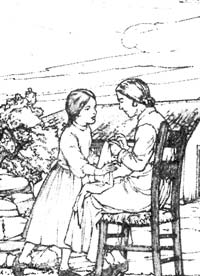
I then remembered to ask Her about two girls who had recently died. They were my friends and used to come to my house to learn weaving from my older sister:
“Is Maria das Neves already in Heaven?”
“Yes, she is in Heaven.”
“And Amelia?”
“She will remain in Purgatory until the end of the world.”
Then She said:
“Do you want to offer yourselves to God to endure all the sufferings He may wish to send you, in an act of reparation for the sins by which He is offended and as a supplication for the conversion of sinners?”
“Yes, we do.”
“Then you will have much to suffer, but the grace of God will be your comfort.”
It was while She said these last words that She opened Her hands for the first time, and we were enveloped in a light so intense—a kind of radiance that streamed from Her hands and penetrated our hearts and the innermost depths of our souls. That light made us see ourselves in God, who was that light, more clearly than we see ourselves in the best of mirrors. Then, moved by an inner impulse also communicated to us, we fell to our knees and repeated inwardly:
“Most Holy Trinity, I adore You. My God, my God, I love You in the Most Blessed Sacrament.”
After a few moments, Our Lady added:
“Pray the Rosary every day to obtain peace for the world and the end of the war.”
Then She began to rise serenely, ascending toward the east, until She disappeared into the immensity of the sky.
It was Jacinta who, unable to contain such great joy, broke our agreement not to speak of it to anyone. That same afternoon, while we were pensive and taken by surprise, Jacinta suddenly exclaimed with enthusiasm:
“Oh, that beautiful Lady!”
“I see you’re already about to tell someone,” I said to her.
“No, I won’t tell anyone, don’t worry,” she replied.
The next day, when her brother came to tell me she had spoken the night before at home, Jacinta listened to the accusation without saying a word.
“See? It was true what I suspected,” I said to her.
“There was something inside me that wouldn’t let me keep quiet,” she replied with tears in her eyes.
“Now don’t cry, and don’t say anything else to anyone about what the Lady told us.”
“But I already told it!”
“What did you say?”
“I said the Lady promised to take us to Heaven.”
“And you immediately went and said that!”
“Forgive me. I won’t say anything else to anyone.”
The next day after the first apparition, when we arrived at the pasture, Jacinta sat on a rock, thoughtful.
“Jacinta, come play!” we said.
“Today I don’t feel like playing.”
“Why not?”
“Because I’ve been thinking: that Lady told us to say the Rosary. So now, when we pray it, we must say the Hail Mary and the Our Father all the way through.”
So from that day, we began to recite the full Rosary properly.
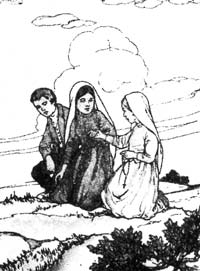
On June 13, our parish was celebrating the feast of St. Anthony. My mother and sisters, knowing how much I loved the festivities, said to me:
“Let’s see if you’ll skip the feast to go to Cova da Iria to speak with that Lady!”
They kept up their attitude of contempt, which hurt me more than insults.
Around eleven o’clock, I left the house, passed by my uncle’s where Jacinta and Francisco were waiting for me, and off we went to Cova da Iria, hoping for the longed-for moment.
That day I felt very sad. Perhaps because of this, the Lady said to me not to lose heart, because She would never abandon me.
After praying the Rosary with Jacinta, Francisco, and the people present, we again saw the reflection of light approaching (what we called lightning), and shortly after, the Lady appeared over the holm oak, just like in May.
“What do you want from me?” I asked.
“I want you to come here on the 13th of next month, to pray the Rosary every day, and to learn to read. Later I will tell you what I want.”
I asked for the healing of a sick person:
“If he converts, he will be healed within the year.”
“I would like to ask You to take us to Heaven.”
“Yes, I will take Jacinta and Francisco soon, but you will stay here for some time. Jesus wants to use you to make Me known and loved. He wants to establish devotion to My Immaculate Heart in the world.”
“Will I stay here alone?” I asked, sorrowful.
“No, My child. And do you suffer much? Don’t lose heart. I will never abandon you. My Immaculate Heart will be your refuge and the way that will lead you to God.”
It was while saying these words that She opened Her hands and once again communicated to us the reflection of that immense light, in which we saw ourselves as if immersed in God. Jacinta and Francisco seemed to be in the light that rose toward Heaven, and I in the one that spread over the earth. In front of the palm of Our Lady’s right hand was a heart encircled by thorns, which seemed to be piercing it. We understood it was the Immaculate Heart of Mary, offended by the sins of humanity, and in need of reparation.
Meanwhile, news of the apparitions had spread. My mother wanted me, at all costs, to admit that it was all lies. She used affection, threats, and even the broomstick to try to make me confess.
As the events unfolded, she became increasingly distressed, and resorted to a more serious attempt. One morning she called me and said she would take me to the parish priest:
“When you’re there, you will kneel, tell him you’ve lied, and ask for forgiveness.”
On the way, we passed my aunt’s house, and my mother went in for a moment. I took the opportunity to tell Jacinta what was happening. Seeing me distressed, she let a few tears fall and said:
“I’ll get up early and go call Francisco. We’ll go to your well to pray. When you come back, join us.”
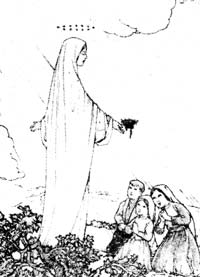
Returning, I ran to the well, and there they were, both on their knees, praying. As soon as they saw me, Jacinta ran to hug me and asked how I had behaved. I told her. She then said:
“See? We mustn’t be afraid of anything. That Lady will always help us. She’s such a dear friend of ours!”
One day, three men came to speak with us. After their unpleasant interrogation, they left saying:
“See if you decide to reveal the secret, otherwise the Administrator is determined to put an end to your lives.”
Jacinta, her face shining with joy, said:
“Oh, what joy! I love Our Lord and Our Lady so much, and now we’ll go see Them soon!”
As the rumor spread that the Administrator really wanted to kill us, one of my aunts, who lived in Casais, came to take us to her house because, she said, “I live in another district and that Administrator won’t be able to find you there.”
But her plan failed, because we refused to leave, saying:
“If he kills us, it doesn’t matter. We’ll go to Heaven!”
The days passed, and on July 13, a few minutes after arriving at Cova da Iria near the holm oak, among a large crowd, while we were praying the Rosary, we saw the familiar reflection of light, and then Our Lady appeared.
“What do you want from me?” I asked.
“I want you to come here on the 13th of next month, to continue praying the Rosary every day to Our Lady of the Rosary, to obtain peace for the world and the end of the war, because only She can help you.”
“I would like You to tell us who You are and to perform a miracle so that everyone believes You are truly appearing to us.”
“Continue to come here every month. In October, I will tell you who I am, what I want, and I will perform a miracle that everyone will see to believe.”
She continued:
“Sacrifice yourselves for sinners and say many times, especially when you make a sacrifice: O Jesus, it is for love of You, for the conversion of sinners, and in reparation for the sins committed against the Immaculate Heart of Mary!”
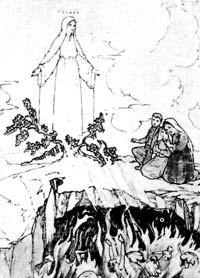
Saying these last words, She opened Her hands again, as in the previous two months. The light seemed to penetrate the earth, and we saw a vast sea of fire, which seemed to be beneath the surface of the earth. Immersed in this fire were demons and souls like burning embers, black or bronze, in human form, floating in the flames amid clouds of smoke, falling in every direction, like sparks in a great fire, without weight or balance, amid screams and groans of pain and despair that horrified us and made us tremble with fear. The demons were distinguishable by their horrible and repulsive forms of unknown animals, black and transparent like burning coals.
Terrified and as if pleading for help, we looked up to Our Lady, who said with sadness and kindness:
“You have seen Hell, where the souls of poor sinners go. To save them, God wants to establish in the world devotion to My Immaculate Heart. If what I say is done, many souls will be saved and there will be peace. The war is going to end. But if people do not stop offending God, another, worse war will begin during the pontificate of Pius XI. When you see a night illuminated by an unknown light, know that it is the great sign God is giving you, that He is about to punish the world for its crimes by means of war, famine, and persecutions of the Church and the Holy Father. To prevent this, I will ask for the consecration of Russia to My Immaculate Heart and the Communion of Reparation on the First Saturdays. If My requests are heeded, Russia will convert, and there will be peace. If not, she will spread her errors throughout the world, causing wars and persecutions of the Church. The good will be martyred, the Holy Father will suffer greatly, many nations will be annihilated. In the end, My Immaculate Heart will triumph. The Holy Father will consecrate Russia to Me, and she will be converted, and a period of peace will be granted to the world.”
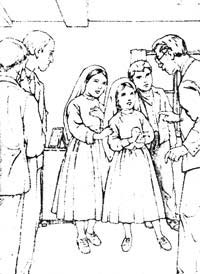
During the apparition, Our Lady confided in us a secret, expressly forbidding us to reveal it to anyone. At the end of the apparition, the crowd rushed toward us, bombarding us with questions that I tried to answer as best I could. They even asked why I had suddenly become so sad. I replied that it was a secret.
After that apparition, Jacinta often began to say:
“Many souls go to hell! And once there, can they ever come out?”
“No!”
“And after many, many years?”
“No! Hell never ends!”
“Not even heaven?”
“Don’t you see that it’s eternal, that it never ends?”
We often meditated on hell and eternity. The vision of hell had filled us with such horror that all penances and mortifications seemed nothing if they could save even a single soul. Jacinta would often sit on the ground or on a stone and, lost in thought, begin to say:
“Hell! Hell! How I pity the souls that go to hell, those people who, alive, burn there like wood in a fire!”
Then, trembling, she would kneel, hands joined, and repeat the prayer the Blessed Virgin had taught us:
“O my Jesus, forgive our sins, save us from the fires of hell, and lead all souls to Heaven—especially those most in need of Your mercy.”
From time to time she would call me or her brother, almost awakening from a dream:
“Francisco! Francisco! Will you pray with me? We must pray a lot, to free souls from hell. So many go there! How I pity the sinners! If only I could show them hell!”
Sometimes she would suddenly cling to me, saying:
“I will go to Heaven, but you must stay here: if Our Lady lets you come, tell everyone what hell is like, so that they will not sin anymore and so they won’t go there.”
When I saw her very thoughtful, I asked: “Jacinta, what are you thinking about?”
More than once she replied:
“About the war that will come, about so many people who will have to die and go to hell! How sad! If people would stop offending God, there would be no war, nor would they go to hell.”
Later, two priests came to question us and urged us to pray for the Holy Father. Jacinta asked who the Holy Father was, and the kind priests explained to us who he was and why he needed prayers. After that, Jacinta developed such great love for the Holy Father that, while offering her sacrifices to Jesus, she always added:
“…and for the Holy Father.”
At the end of the Rosary she would always add three Hail Marys for him. And sometimes she said:
“How I would like to see the Holy Father! So many people come here, but the Holy Father never comes.”
In her childlike innocence, she thought that the Supreme Pontiff could make that journey like anyone else.
One day we were taking a siesta near my parents’ well. Jacinta was seated at the edge of the well, while Francisco and I went to gather wild honey in the bushes on a nearby slope. Later, Jacinta called me:
“Did you see the Holy Father?”
“No.”
“I don’t know what happened. I saw the Holy Father in a very large house, kneeling before a table, weeping, his face in his hands. Outside the house were many people; some were throwing stones at him, others were shouting curses and using very vulgar words. Poor Holy Father! We must pray a lot for him!”
On another occasion, we went to the Cabeço grotto. We knelt on the ground to say the Angel’s prayer. After a while, Jacinta rose and called me:
“Don’t you see so many roads, so many paths and fields full of people crying from hunger and having nothing to eat? And the Holy Father in a church, before the Immaculate Heart of Mary, in prayer? And so many people praying with him?!”
From then on, with every prayer or sacrifice we offered to God, we also added a prayer for His Holiness. We began to feel such a great love for the Holy Father.
Meanwhile, the dawn of August 13 arrived. People came from every direction, some even the day before. Everyone wanted to see us, question us, and make their requests so that we could relay them to the Blessed Virgin. In the morning, the mayor sent an order for me to go to my aunt’s house, where he was waiting for me. My father received the order and took me there.
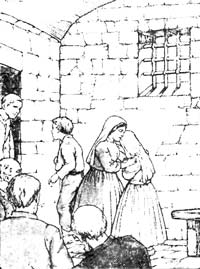
When we arrived, he was in a room with my cousins. He questioned us and made further attempts to force us to reveal the secret and promise not to return to Cova da Iria. Failing to achieve anything, he ordered my father and uncle to take us to the parish priest. From there, he then put us in his carriage under the pretense of taking us to the Cova but instead brought us to Vila Nova de Ourém, where his residence and the government offices with the jail were located. He kept us at his home for a while, subjecting us to new interrogations, promises, and threats to force the secret from us. Finding all attempts useless, he had us locked in prison.
While we were imprisoned, what cost Jacinta the most was the abandonment by our parents. She would say tearfully:
“Neither my parents nor yours have come to see us. They don’t care about us!”
“Don’t cry,” Francisco told her, “let’s offer this to Jesus for sinners.”
And, raising her eyes and small hands to Heaven, she made the offering:
“O my Jesus, it is for Your love and for the conversion of sinners.”
Jacinta added:
“And also for the Holy Father and in reparation for the sins committed against the Immaculate Heart of Mary.”
When, after separating us, they brought us back together in one room of the prison and told us they would soon come for us to have us fried—wrongly believing we had hidden something—Jacinta moved to a window overlooking the livestock market field. I thought she was distracted by the view, but soon realized she was crying.
I went to comfort her and asked why she was crying.
“Because,” she said, “we will die without seeing our parents,” and tears ran down her face.
“I would at least like to see my mother again!”
“Then don’t you want to offer this sacrifice for the conversion of sinners?”
“Yes, yes, I want to!” she replied, her cheeks wet with tears, eyes raised to heaven, making her offering:
“O my Jesus! It is for Your love, for the conversion of sinners, for the Holy Father, and in reparation for the sins committed against the Immaculate Heart of Mary!”
A prisoner who witnessed this scene tried to console us:
“Come on now, tell the Administrator this secret! What does it matter if this Lady doesn’t want you to?”
“Ah! That, no,” Jacinta replied quickly. “I’d rather die.”
We then decided to pray our Rosary. Jacinta took a medal she wore around her neck, asked one of the prisoners to hang it on a nail fixed in the wall—and, kneeling before that medal, we began to pray. The prisoners prayed with us, as much as they knew how—at least they knelt. After the Rosary, Jacinta returned to the window to cry:
“Jacinta! So you don’t want to offer this sacrifice to Our Lord?” I asked her.
“Yes, I do, but I think of mother and cry without meaning to.”
Since the Blessed Virgin had told us to offer also our prayers and sacrifices in reparation for the sins committed against Her Immaculate Heart, we thought among ourselves to dedicate each offering with a particular intention: one for sinners, another for the Holy Father, the third in reparation. I asked Jacinta which intention she wanted to offer for.
“I offer it for all of them, because I love them all.”
There was a prisoner who played the harmonica. They began to play and sing to cheer us up. They asked if we knew how to dance. We replied we knew the fandango and the vira (two traditional dances). Jacinta then danced with a poor thief who, seeing how small she was, danced holding her in his arms. May Our Lady have mercy on his soul and convert him!
During the imprisonment, what hurt me most and caused suffering to me and my cousins was our family’s complete abandonment. After returning from prison— which I believe occurred on August 15 (though the apparition actually happened on August 19, note)—as soon as I arrived home, I was immediately told to take the flock out to pasture. My uncles chose to stay with Jacinta at home and instead sent her brother João. Since it was already late, we stopped near our site, at Valinhos. Feeling that something supernatural was approaching and enveloping us, suspecting that the Lady was about to appear and regretting that Jacinta wasn’t there to see Her, we asked João to go call her. Since he didn’t want to, I offered him two pennies and he ran to fetch her. Meanwhile, I saw, with Francisco, the flash of light we called lightning—and with Jacinta arriving an instant later, we saw Our Lady above the holm oak.
“What do you want from me?” I asked.
“I want you to continue going to Cova da Iria on the 13th and to continue praying the Rosary every day. In the last month, I will perform the miracle so that everyone will believe.”
“What do You wish to be done with the money and other offerings that the people leave at Cova da Iria?”
“Have two processional litter‑carriers made; one you will carry, Giacinta, with two other girls, the other Francisco with three other children of the same age, all dressed in white mantles. The rest of the money is for the feast of Our Lady of the Rosary.”
“I would like to ask You for the healing of some sick people.”
“Yes, I will heal some of them during the year,” said the Virgin, and, taking on a very sad aspect, added:
“Beware, many souls go to Hell because there is no one to sacrifice and pray for them: pray, pray a lot and make sacrifices for sinners.”
As usual, She began to ascend toward the east. From that day on, as the Blessed Virgin had asked, we resolved to make sacrifices for sinners.
Jacinta asked, “And how shall we make sacrifices?”
Francisco quickly discovered a good one: “Let’s give our rations to the sheep and make the sacrifice of skipping snack.”
Within minutes, all our provisions had been distributed to the flock, and we spent that day fasting as austerely as the strictest Carthusian monk. The boys of two families from Moita went begging door to door. We had met them one day while leading our flocks. Seeing them, Jacinta said:
“Let’s give our provisions to these poor children for the conversion of sinners.”
And she ran to bring them to the children.
When we thought or had something to endure, Jacinta always asked:
“Have you already told Jesus it is for love of Him?”
If I answered no, she said:
“Then I myself will tell Him.”
And, joining her small hands, she raised her eyes to heaven and said:
“O Jesus, it is for love of You and for the conversion of sinners.”
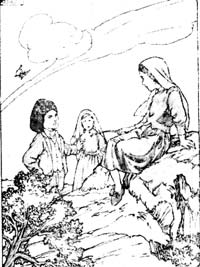
On September 13, 1917, as the hour approached, I set out with Jacinta and Francisco through a large crowd that barely let us pass. The roads were filled with people. Everyone wanted to see and speak with us. There was no human respect—many people, even ladies and gentlemen, managed to break through the crowd that pressed around us and threw themselves on their knees before us, asking us to present their needs to Our Lady. Others, unable to get close, shouted from afar:
“For the love of God, ask Our Lady to heal my son, who is a poor cripple!”
Another: “That she heal my son, who is blind!”
Another: “Mine, who is deaf; that she bring my husband home, my son from the war; that she convert a sinner; that she give me health, because I have tuberculosis!” and so on.
All the miseries of poor humanity were present. Some people even cried out from the tops of trees or walls they had climbed just to see us pass.
Now, when I read those enchanting scenes in the New Testament of Jesus passing through Palestine, I remember these ones that the Lord, though I was still a child, allowed me to witness.
We finally arrived at the Cova da Iria, by the holm oak, and began to pray the Rosary with the people. Soon we saw the flash of light and then Our Lady above the tree.
“Continue to pray the Rosary to obtain the end of the war. In October, the Lord will come, as well as Our Lady of Sorrows, Our Lady of Mount Carmel, and Saint Joseph with the Child Jesus, to bless the world. God is pleased with your sacrifices, but He does not want you to sleep with the rope. Wear it only during the day.”
“People have asked me to request many things: the healing of some sick people, of a deaf-mute.”
“Yes, I will heal some, but not others. In October, I will perform the miracle so that all may believe.”
And, as she began to rise, she disappeared as usual.
We dedicated ourselves so much to making sacrifices for sinners that we didn’t let a single opportunity slip by. Jacinta especially seemed insatiable in her love of sacrifice.
One day, a neighbor offered us a good pasture for our flock, but it was far away, and it was the middle of summer. My mother accepted the generous offer, and we were sent there. The day was beautiful, but the blazing sun seemed to burn everything. We were terribly thirsty, and there wasn’t a drop of water to be found!
At first, we offered this sacrifice with great generosity for the conversion of sinners. But after midday, we could hardly endure it. I suggested to my cousins that I would go to a nearby house and ask for water. They agreed. I knocked on an old woman’s door, and she kindly gave me a jug of water—and even a piece of bread, which I gratefully accepted and ran back to share with my cousins.
Then I handed the jug to Francisco and told him to drink.
“I don’t want to.”
“Why not?”
“I want to suffer for the conversion of sinners.”
“Drink, Jacinta.”
“I also want to offer this sacrifice for sinners.”
So I poured the water into a hollow in a rock for the sheep to drink and returned the jug to its owner.
We also had the habit of offering novenas or entire months without drinking water as sacrifices to the Lord. We once made such a sacrifice in August, during suffocating heat.
Another time, my aunt called us to eat some figs she had brought home, which looked delicious. Jacinta sat down with us, satisfied, right by the basket, and grabbed the first fig to eat it—but then suddenly remembered and said:
“Oh, that’s right! Today we haven’t made any sacrifice for sinners! Let’s make this our sacrifice!”
She put the fig back in the basket, made the offering, and we didn’t touch the figs at all.
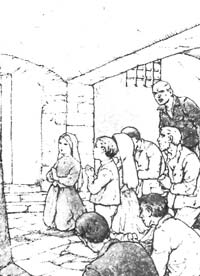
One day, we went to a place full of oaks and holm oaks. The acorns were still quite green, but I told Jacinta we could eat them. Francisco climbed a holm oak to pick some and fill his pockets. But Jacinta immediately thought we could pick the more bitter acorns from the oaks to make a greater sacrifice—and so we enjoyed these “delicious” foods. Jacinta often made this one of her regular sacrifices. She used to pick acorns or bitter olives.
I once told her:
“Jacinta, don’t eat those—they’re too bitter.”
“That’s exactly why I eat them, for the conversion of sinners.”
That wasn’t our only fasting. We had decided to always give our lunch to the little beggars from Moita whenever we met them. These poor kids, happy with our alms, began to wait for us on the road. Every time we saw them, Jacinta would run to give them our food, as if she didn’t mind going hungry herself.
One day, while walking with our sheep along a path, I found a piece of rope. I picked it up and, just joking, tied it around one arm. I soon noticed it hurt. I told my cousins:
“Look! This rope hurts! We could tie it around our waists and offer the suffering to God.”
Those poor children agreed right away. We cut the rope into three parts using the edge of a rock as a knife. The rope was rough and thick, and sometimes we tied it too tight, which made it hurt terribly. Sometimes Jacinta would shed tears, and when I told her to take it off, she would say:
“No! I want to offer this sacrifice to the Lord in reparation and for the conversion of sinners.”
On October 13, 1917, we left home very early, anticipating delays. There was a huge crowd and torrential rain. My mother, fearing it might be the last day of my life and heartbroken over the uncertainty of what would happen, wanted to come with me. Along the way, the scenes from the previous month were repeated, only more numerous and moving. Not even the mud of the paths stopped people from kneeling in humble and pleading attitudes.
When we reached the Cova da Iria, near the holm oak, moved by an interior instinct, I told people to close their umbrellas before praying the Rosary.
Soon we saw the flash of light and then Our Lady above the tree.
“What do You want of me?”
“I want to tell you to have a chapel built here in my honor. I am the Lady of the Rosary. Continue to pray the Rosary every day. The war will end, and the soldiers will soon return home.”
“I have many things to ask You: to heal the sick and to convert some sinners.”
“Some yes, others no. They must amend their lives and ask forgiveness for their sins.”
And taking on a more sorrowful expression, she said:
“Do not offend the Lord our God anymore, for He is already too greatly offended.”
Then, opening her hands, she made them reflect light into the sun. As she rose, the reflection of her light continued shining into the sun.
That’s why I cried out for the people to look at the sun. My intention was not to draw their attention to it—I wasn’t even aware of the sun’s presence. I did so only under the impulse of an interior inspiration.
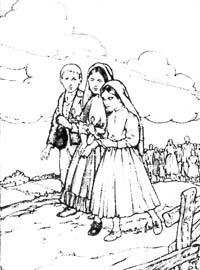
After Our Lady vanished into the immensity of the firmament, we saw beside the sun Saint Joseph with the Child Jesus and Our Lady, dressed in white with a blue mantle. Saint Joseph and the Child Jesus seemed to bless the world, making the Sign of the Cross with their hands.
Shortly afterward, this vision faded, and I saw the Lord and Our Lady, who appeared to be Our Lady of Sorrows. The Lord also blessed the world as Saint Joseph had done.
Then this vision disappeared, and it seemed to me that I saw Our Lady again, in the form of Our Lady of Mount Carmel.
And this is the story of the apparitions of Our Lady at the Cova da Iria.
Lucia adds:
“Of all the words spoken by Our Lady, the ones that most deeply impressed my heart were: ‘Do not offend the Lord our God anymore, for He is already too greatly offended!’ What a loving plea and tender request! Oh, if only it could echo throughout the world, and if all the children of the Heavenly Mother could hear the sound of her voice!”
I will begin to write what the good God allows me to remember about Giacinta. She always had a serious, modest, and lovable expression, which seemed to reveal the presence of God in everything she did—just like elderly people of great virtue.
I never saw in her the excessive lightheartedness or excitement typical of children about decorations or amusements. That was after the apparitions; before, she was the number one when it came to enthusiasm and whims.
She had a particular fondness for dancing and was very talented at it. Sometimes, just hearing any instrument played by the shepherds was enough for her to start dancing—even by herself.
After the apparitions, when Carnival time approached, she told me:
“I don’t dance anymore now.”
“Why not?”
“Because I want to offer this sacrifice to the Lord.”
Since we were the ones who usually led the children’s parties, dancing came to an end at those occasions.
One day, my mother, in agreement with my aunt, decided to sell the flock and send us to school.
Giacinta enjoyed going to visit the Blessed Sacrament during breaks, but she would say:
“It’s like they can guess it. As soon as I enter the church, there’s a crowd asking questions! I would love so much to stay there a long time, speaking with hidden Jesus, but they never let me!”
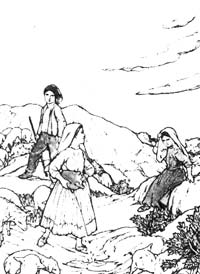
She was so dear to Our Lady’s Heart that any grace she asked for was granted.
One day, we were met by a poor woman who, crying, knelt in front of Giacinta, begging her to obtain from Our Lady healing from a terrible illness.
Giacinta, seeing this afflicted woman kneeling before her, took her trembling hands to raise her up. But, seeing that she couldn’t, she knelt too and prayed three Hail Marys with the woman. Then she told her to get up, saying that Our Lady would heal her.
She never stopped praying for her every day until, some time later, the woman returned to thank Our Lady for the healing.
Another time, there was a soldier who cried like a child. He had been ordered to go to war and was leaving behind his wife, bedridden, and three little children.
He was asking either for his wife’s healing or for the order to be revoked.
Giacinta invited him to pray the Rosary with her. Then she said:
“Don’t cry anymore. Our Lady is so good! She will certainly grant you the grace you’re asking for!”
She never forgot that soldier. At the end of each Rosary, she would always say one Hail Mary “for my soldier.”
A few months later, he returned—with his wife and children—to thank Our Lady for the two graces he had received: he had been excused from military service due to a fever he caught the day before leaving, and his wife, he said, had been healed through a miracle of Our Lady.
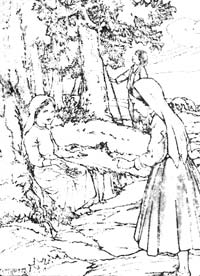
Another grace was granted to my aunt Vitória, who had a son that had left home a long time before, and no one knew where he was.
Worried, she came one day to Aljustrel to ask me to pray to Our Lady for her son. Not finding me, she asked Giacinta, who promised to pray for him.
A few days later, the boy reappeared at home, asking forgiveness from his parents. Then he went to Aljustrel to tell the story of his misfortunes.
After spending what he had stolen from his family, he had wandered for a while, vagrant, until—for reasons he didn’t explain—he was imprisoned in Torres Novas.
Some time later, one night he managed to escape and, lost in the darkness of unfamiliar mountains and pine forests, terrified of being caught again, he turned to prayer.
He fell to his knees and began to pray. After a few minutes, Giacinta appeared to him, took his hand, and led him to the provincial road from Alqueidão to Reguengo, signaling for him to follow it.
By morning, he found himself on the path to Boleiros. He recognized the place and, moved, headed home.
I asked Giacinta if it was true she had gone to him. She replied no, that she didn’t even know where those forests or mountains were.
“I only prayed and begged Our Lady for him, out of compassion for Aunt Vitória.”
“Then how did all this happen?” I asked.
“I don’t know—that’s something the Lord knows.”
Thus passed the days of Giacinta.
On December 23, 1918, the Spanish flu put Giacinta and her little brother to bed.
Just before falling ill, she had told me:
“My head hurts so much, and I’m so thirsty! But I don’t want to drink, to suffer for sinners.”
During the illness of my two cousins, every moment I had free from school or chores, I ran to be with them.
One day, as I was passing on my way to school, Giacinta said:
“Tell Hidden Jesus that I love Him very much, that I love Him with all my heart.”
Other times she’d say:
“Tell Jesus I send Him lots of kisses.”
When I went to her room first, she would say:
“Now go to Francisco—I’ll make the sacrifice of staying here alone.”
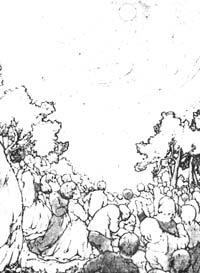
One day her mother brought her a cup of milk and told her to drink it.
“I don’t want it, Mama,” she replied, pushing the cup away with her hand.
My aunt insisted a bit, then left, saying:
“I don’t know how to get her to eat anything, she’s so nauseous!”
As soon as we were alone, I asked her:
“Why are you disobeying your mother? Why don’t you offer that sacrifice to the Lord?”
At these words, she shed a few tears, which I had the joy of wiping away, and said:
“This time, I forgot!”
She called her mother back, asked for forgiveness, and said she would take whatever she wanted.
Her mother brought the milk again. She drank it without showing any disgust. Then she said to me:
“If you only knew how hard it was for me to drink that!”
A few days later she said:
“It gets harder and harder to take the milk and broths, but I say nothing. I drink it all for the love of the Lord and the Immaculate Heart of Mary, our good Heavenly Mother.”
Once I asked her:
“Are you feeling better?”
“You already know I’m not better. My chest hurts so much! But I say nothing—I suffer for the conversion of sinners.”
One day she had me called urgently. I ran to her and she said:
“Our Lady came to visit us. She said that very soon she will come to take Francisco to Heaven. She asked me if I still wanted to convert more sinners. I told her yes. She said I would go to the hospital, where I will suffer a lot. That I would suffer for the conversion of sinners, in reparation for the sins committed against the Immaculate Heart of Mary, and for love of Jesus. I asked her if you would come with me. She said no. That’s what costs me the most. She said my mother will take me to the hospital, but then I’ll be alone there!”
She remained thoughtful for a while and then added:
“If only you could come with me! What hurts the most is going there without you.”
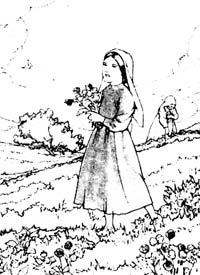
When the moment came for her brother to leave for Heaven, she gave him her final words:
“Give many greetings to the Lord and the Blessed Virgin. Tell Them that I will suffer everything They want, to convert sinners and to make reparation for the offenses committed against the Immaculate Heart of Mary.”
She suffered greatly from her brother’s death. She often sat lost in thought, and if someone asked her what she was thinking about, she would reply:
“About Francisco. Oh, if only I could see him again!”
And her eyes would fill with tears.
At the beginning of July 1919, the day finally came for her to enter the hospital in Vila Nova, where she truly suffered a great deal. When her mother went to visit her, she brought me along. I asked her then if she was in much pain: “Yes, I suffer, but I like to suffer very much for the love of our good God, for the Immaculate Heart of Mary, for sinners, and for the Holy Father.” This was her ideal; this was what she spoke about.
She returned once again for some time to her parents’ home towards the end of August 1919, with a large open wound in her chest, whose treatment she endured without a complaint, without showing the slightest sign of discomfort. What troubled her most were the frequent visits and interrogations from people who came looking for her, from whom she could no longer hide. “I offer this sacrifice also for sinners,” she said with resignation.
Once more, the Most Holy Virgin deigned to visit Giacinta to announce new crosses and sacrifices. She told me about it and said: “She told me that I will go to Lisbon, to another hospital, that I will never see you again, nor my parents. That, after suffering much, I will die alone. But I should not be afraid, because She will come there to take me to Heaven.” Crying, she hugged me and said: “I will never see you again. You will not come to see me there. Listen! Pray a lot for me, because I will die alone.” “Don’t think about it,” I said to her. “Let me think about it, because the more I think about it, the more I suffer, and I want to suffer for the love of the Lord and for sinners. And besides, I don’t care at all! The Madonna will come there to take me to Heaven!”
Sometimes she asked me: “Will I then die without receiving the Hidden Jesus? If only the Madonna would bring Him to me when she comes to take me!”
When her mother appeared sad to see her so ill, she said to her: “Don’t be sad, Mama, I am going to Heaven. Up there I will pray a lot for you.” Other times she said: “Don’t cry, I am well.” When asked if she needed anything, she replied: “Thank you very much, I don’t need anything.” When they left, she said: “I am very thirsty, but I don’t want to drink; I offer it to Jesus for sinners.”
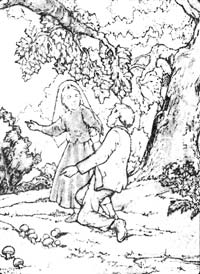
Finally, the day came to leave for Lisbon, January 21, 1920. The moment of farewell broke my heart. She stayed clinging to my neck for a long time and said, crying: “We will never see each other again! Pray a lot for me, until I go to Heaven. Then up there, I will pray a lot for you. Never tell the secret to anyone, not even if they kill you. Love Jesus very much and the Immaculate Heart of Mary, and make many sacrifices for sinners.”
From Lisbon she sent word that the Madonna had already visited her and told her she would die on February 20 at 10:30 p.m.; she urged me to be very good.
This is what I remember of Giacinta’s life. I ask our good God to deign to accept this writing, to kindle in souls the flame of love for the Hearts of Jesus and Mary.
The friendship that bound me to Francesco was barely that of kinship and that which the graces, which Heaven deigned to grant us, brought with them.
Francesco did not seem like Giacinta’s brother, except in the features of his face and in the practice of virtues. He was not capricious and lively like her. On the contrary, he was of a peaceful and gentle character.
When in our games someone stubbornly denied him his rights as winner, he would give in without resistance, merely saying: “You think you have won? Very well! I don’t care!”
Always smiling, always kind and gentle, he played with all the children without distinction. He never scolded anyone. Only sometimes he would withdraw when he saw something was wrong.
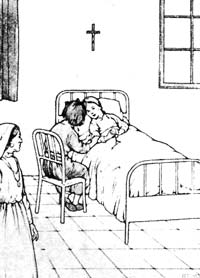
After the apparitions of the Madonna, he became increasingly fond of solitude. The first apparition left us with a peace and expansive joy that did not prevent us from talking about what had happened. To Francesco, who had not heard, we told what the Madonna had communicated to us, including the promise to take him to Heaven if he recited many Rosaries. From that day he took to distancing himself from us, as if for a walk. And if I called him and asked what he was doing, he would raise his hand and show his Rosary. If I told him to come play, saying he would pray with us afterwards, he replied: “I pray even after. Don’t you remember the Madonna said to recite many Rosaries?!”
He prayed a lot even when we were taken to prison. Throughout the time he showed himself quite cheerful and tried to comfort Giacinta in her moments of greatest longing. When we prayed the Rosary, he saw that one of the prisoners was kneeling with his beret on his head; he approached him and said: “Sir, if you want to pray, you must take off your beret.” The poor man immediately gave it to him and he put it on top of his hood, on a stool.
While they were interrogating Giacinta, he told me with immense peace and joy: “If they kill us, as they say, soon we will be in Heaven! How beautiful! I don’t care about anything.” After a moment of silence: “God willing, Giacinta will not be afraid. I will say a Hail Mary for her.”
He always showed a maturity far beyond his age. One day, passing with him and Giacinta near the house of the godmother Teresa, she called us and began to celebrate us. Other children started gathering, and the godmother, after offering us various things, wanted to see us dance and sing. At the sound of the lively choir, neighbors gathered around us and at the end asked for an encore.
But Francesco came to me and said: “Let’s not sing anymore. Surely the Lord does not like that we sing these things now.” And so we escaped as best we could from that crowd of boys, toward our favorite well.
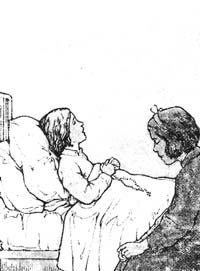
Carnival 1918 came. Children up to 14 years old had their own separate party. Naturally, many came to invite me to organize the party with them. At first, I refused, but overcome by weak compliance, I gave in to the insistence of some. Upon arriving at Giacinta and Francesco’s, I told them what had happened.
“And you are going back to these dinners and amusements?” Francesco asked me seriously.
“Have you forgotten that we promised never to go back?”
“I didn’t want to, but you see, they don’t let me, they insist that I go; I don’t know what to do!”
“Do you know what you must do? Everyone knows that the Madonna appeared to you. So you say you promised Her never to dance again, and for that, you won’t go! Then, that day, we’ll run away to the Cabeço cave. There no one will find us.”
I accepted the idea; once my decision was known, no one thought of organizing the gathering anymore. God blessed us. And those friends, who before sought me out for fun, now followed me and looked for me at home on Sunday afternoons so that I would go with them to recite the Rosary at the Cova d’Iria.
Francesco was a man of few words; to say his prayers and offer his sacrifices, he liked to hide even from Giacinta and me. More than once we surprised him behind a wall or a hedge, where he had secretly hidden, kneeling, to pray or to think, as he said, about the Lord, sad because of so many sins.
Once I asked him: “Francesco, what do you like more, to console the Lord or to convert sinners so that no more souls go to Hell?”
“I like more to console the Lord. Didn’t you notice how the Madonna, even in the last month, became so sad when she said not to offend the Lord God any more, who is already so offended? I want to console the Lord and then convert sinners so that they won’t offend Him anymore.”
When he went to school, arriving at Fatima, he sometimes said to me: “Listen, you go to school. I’ll stay here, in church, near the Hidden Jesus. For me, it’s not worth learning to read; soon I will go to Heaven. When you come back, come and get me.”
One day, leaving the house, I noticed Francesco was walking very slowly.
“What’s wrong? It looks like you can’t walk!”
“My head hurts a lot, and I feel like I’m about to fall.”
“Then don’t come, stay at home.”
“No. I prefer to stay in church with the Hidden Jesus while you go to school.”
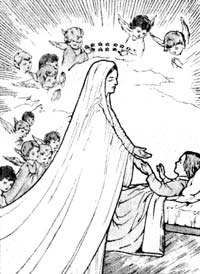
With his prayer, he obtained many graces from Jesus. I will recount a few: before his illness, one day I left the house and met my sister Teresa; she came on behalf of another woman from a nearby village whose son had been arrested on an accusation of some crime I don’t know; if he could not prove his innocence, he would be sentenced to exile, or at least to a good number of years in prison. She therefore asked me insistently to obtain this grace from Our Lady. After receiving the message, I went to school; on the way I told the cousins about it. When we arrived at Fatima, Francesco said: “Listen, while you go to school, I’ll stay with the Hidden Jesus and ask Him for the grace.” After school, I called him and asked, “Did you ask the Lord for that grace?” “Yes, tell your Teresa that in a few days he will come back home.” Indeed, within a few days the poor young man returned home and, on the 13th, came with his whole family to thank Our Lady for the grace received.
There was also a woman from Alqueidao who wanted the healing of a sick person and the conversion of a sinner. Francesco said: “I will pray for this woman, you pray for the others, since there are many.” That woman appeared shortly after Francesco’s death; she asked me where his grave was because she wanted to go there to thank him for the two graces she had received.
One day, a poor woman and a young man (they were mother and son) knelt before Francesco to ask him to obtain from Our Lady the healing of the father and, for him, the grace of not going to war. Francesco knelt down as well, took off his hood, and asked if they wanted to pray the Rosary with him. They said yes and began to pray. Afterwards, they accompanied us to the Cova d’Iria. Along the way, they said another Rosary with us and there, at the place, another one, then they left satisfied. The poor woman promised to return to thank Our Lady for the graces asked for, if she received them. And she indeed returned several times, not only with her son but also with her husband, who was already in good health.
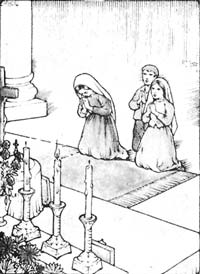
On December 23, 1918, Francesco became ill along with Giacinta with the Spanish flu, which took his life in a few months.
During his illness, he was always cheerful and happy. Sometimes I asked him: “Francesco, do you suffer a lot?” “Enough, but it doesn’t matter. I suffer to console the Lord and soon I will go to Heaven!”
He sometimes told me, when I passed by him on my way to school: “Listen, go to church and give many greetings to the Hidden Jesus for me. What I regret most is not being able to spend a few minutes with the Hidden Jesus.”
Another time I asked him: “Francesco, do you feel very bad?” “Yes, but I suffer to console the Lord.”
One day, entering his little room with Giacinta, he said:
“Today talk little because my head hurts a lot.”
“Don’t forget to offer everything for the sinners,” Giacinta told him.
“Yes, but first I offer to console the Lord and the Madonna, and then after I offer for the sinners and for the Holy Father.”
Another day I found him very happy.
“Are you better?”
“No, I feel much worse. Now I am almost ready to go to Heaven. Up there I will console the Lord and the Madonna a lot. Giacinta will pray a lot for sinners, for the Holy Father and for you; and you will stay down here because Our Lady wants it. Listen, do everything she tells you.”
While Giacinta seemed worried with the single thought of converting sinners and freeing souls from Hell, Francesco seemed to think only about consoling the Lord and the Madonna, who had seemed so sad to him.
One day, a woman from Casa Velha named Marianna entered Francesco’s room. She was distressed because her husband had kicked a son out of the house and asked for the grace of reconciliation between the son and the father. Francesco replied: “Be calm. I will soon go to Heaven and when I arrive up there I will ask Our Lady for this grace.”
I don’t remember exactly how many days he waited to go to Heaven; I only remember that the evening of the day Francesco died, the son finally asked forgiveness from his father, who had refused before because the son did not submit to the imposed conditions. He submitted to everything the father imposed and peace was restored in that house.
A few days before dying he told me: “Listen, I feel very bad, now I am almost ready to go to Heaven.”
One early morning his sister Teresa came to call me: “Come! Francesco is very sick and wants to tell you something.”
I dressed quickly and went to him. He asked his mother and siblings to leave because what he wanted to tell me was a secret. They left and he told me: “I am about to confess, to take Communion and then die. I want you to tell me if you have ever seen me commit any sin, and to go ask Giacinta if she also saw me commit any.”
“You have disobeyed mother a few times,” I replied, “when she told you to stay home and instead you ran away to come to me or to hide.”
“That’s true, I have that sin. Now go ask Giacinta if she remembers any others.”
I went, and Giacinta, after thinking for a bit, answered: “Look, tell him that even before the Madonna appeared to us, he stole a coin from Dad to buy a little organ for Giuseppe Marto from Casa Velha, and when the boys from Aljustrel threw stones at those from Boleiros, he threw some too!”
When I gave him my sister’s answer, he said: “I confessed those, but I’ll confess them again. Maybe it’s because of these sins that the Lord is so sad. Now I am repentant.”
I left and went to my duties.
When I returned, near evening, he was bursting with joy. He had confessed and the priest promised to bring him Holy Communion the next day.
After receiving Communion the next day, he told his little sister: “Today I am happier than you, because I have Jesus hidden in my heart.”
I spent almost the whole day by his bedside with Giacinta. Since he could no longer pray, he asked us to recite the Rosary for him.
Already late at night, I said goodbye: “Francesco, bye. If you go to Heaven tonight, don’t forget me up there, okay?”
“I won’t forget you, no, don’t worry.”
And grabbing my right hand, he squeezed it hard for a long time, looking at me with tears in his eyes.
“Do you want anything else?” I asked, tears running down my cheeks.
“No,” he answered weakly.
“Well then, goodbye, Francesco! See you in Heaven. Farewell, in Heaven!”
…And Heaven was drawing near. He flew there the next day, Friday, April 4, 1919, into the arms of the Heavenly Mother.
My mother, after the apparitions, was forced to sell our flock because so many people always asked to see me and speak to me. This was no small loss for the family’s livelihood. I was blamed for all of it, and everyone threw it in my face during critical moments. I hope that our good God accepted everything since I always offered it to Him gladly, happy to sacrifice myself for Him and for sinners. As for my mother, if she scolded and punished me, it was because she thought I was lying.
In my family, there was another sorrow for which I was blamed, they said. The Cova d’Iria was a piece of land that belonged to my parents. At the bottom, there was some fairly fertile soil where good corn, legumes, vegetables, etc., were planted. However, ever since people started going there, we could no longer cultivate anything. People trampled everything. My mother, lamenting this loss, would say to me: “Now you should be eating what is grown in the Cova d’Iria!” These things saddened me so much that I didn’t even have the courage to take a piece of bread to eat. My mother, to force me to say that the apparitions of Our Lady were all my inventions, several times made me feel the weight of a stick destined for the firewood pile, or the handle of a broom.
One day my mother fell seriously ill, to the point that one day we thought she was dying. All the children gathered around her bed to receive her last blessing. Being the youngest, I was last. The poor mother, seeing me, revived a little and threw her arms around my neck. My eldest sister forcibly tore me from her arms and took me to the kitchen, forbidding me to return to the sickbed, and concluded by saying: “Mother dies saddened by the troubles you have caused her!” I knelt down, rested my head on a stool, and with a deep bitterness I had never felt before, I offered our good God my sacrifice.
A few minutes later, seeing the case was hopeless, they came back to me and said: “Lucia! If it is true that you have seen Our Lady, go now to the Cova d’Iria, ask Her to heal mother. Promise Her whatever you want, and we will do it, and then we will believe.” Without losing a moment, I set out. I took various shortcuts through the fields, saying the Rosary all the way. I made my plea to Our Lady, poured out my sorrow with abundant tears, and returned home, comforted by the hope that my dear Mother of Heaven would restore the health of my earthly mother. When I returned home, my mother was already better; three days later she could already do all the household chores.
Meanwhile, the Mayor and other government men who did not want to accept the events at Fatima sent some men one night by car to cut down the holm oak on which the apparition had occurred. In the morning, the news spread quickly. I ran there immediately to see if it was true. But what joy I felt when I saw that those poor men had made a mistake and had taken away one of the nearby oaks instead of the holm oak. I then asked forgiveness from Our Lady for those poor men and prayed for their conversion.
A few days later, on May 13—though I don’t remember if it was 1918 or 1919—at dawn rumors spread that a cavalry force was at Fatima to prevent people from going to the Cova d’Iria. Everyone came, half frightened, to give me the news, saying that surely this would be the last day of my life. Without paying attention to what they said, I set off toward the church. Arriving at Fatima, I passed among the horses that occupied the entire churchyard, entered the church, attended Mass celebrated by an unknown priest, received Holy Communion, and after giving thanks, peacefully returned home, without anyone saying a word to me. In the evening, despite the continuous news that soldiers were trying unsuccessfully to disperse the crowd, I went there to say my Rosary as well. On the way, a group of women from outside joined me. As we approached the place, two soldiers came toward our group, whipping their horses to catch up with us. When they arrived, they asked where we were going. Hearing the brave reply of the women that it was none of their business, they whipped their horses intending to charge us. The women fled in all directions, and in an instant, I found myself alone in front of the two horsemen. They then asked my name; I gave it without hesitation. They asked if I was the seer. I said yes. They then ordered me to walk in the middle of the road between the two horses, indicating the road to Fatima.
Approaching the swamp, a poor woman who lived there, seeing me at some distance among the horses, threw herself in the middle of the road and, like a second Veronica, tried to encourage me. The soldiers forced her to step back immediately, and the poor woman wept for my misfortune. Arriving at a field a little before entering Aljustrel, near a small spring, seeing some holes dug for planting stakes, they made me stop and, perhaps to frighten me, said: “Here are some open pits. With one of our swords, we will cut off her head and leave it buried down here. That will end this story once and for all.” Hearing these words, I thought my last hour had truly come, but I remained calm, as if it were not about me. After a moment, they let me continue. I crossed our little village. Everyone came to the window or door to see what was happening. Some laughed mockingly, others pitied my fate. When I arrived home, they called my parents. They were not there. The soldiers ordered me not to leave the house that day and, jumping on their horses, they left.
At sunset, rumors spread that the soldiers had retreated, defeated by the people, and at dusk, I prayed my Rosary at the Cova d’Iria, accompanied by hundreds of people.
My father was the only one who continued to show affection toward me, and in the disputes that arose against me in the family, he alone defended me. He was a healthy, strong man who said he did not know what a headache was. One day, in less than twenty-four hours, almost suddenly, double pneumonia took him to eternity. My grief was so great that I thought I would die of it. “My God, my God!” I exclaimed, locked in my room, “I never thought You would keep so much suffering in store for me! But I suffer for Your love, in reparation for the sins committed against the Immaculate Heart of Mary, for the Holy Father, and for the conversion of sinners.”
In a short time, our good God took Francesco to Heaven (April 4, 1919), my dear father (July 31, 1919), and allowed me to be separated from Giacinta, who left for the hospital in Lisbon on January 21, 1920. What sadness I felt seeing myself alone! As soon as I could, I took refuge in the rocky cave where the Angel had appeared to us, to pour out my sorrow alone with God and to shed abundant tears.
Some time later, the news arrived that Giacinta had flown to Heaven. They then brought her body to Vila Nova de Ourém. One day, my aunt took me there, to the mortal remains of her little daughter, hoping to distract me a bit. But for a long time, my sadness seemed only to grow deeper. When the cemetery was open, I would sit on the tomb of Francesco or my father and spend long hours there. Thanks be to God, Don Formigão’s sister promised my mother to arrange for me to enter a boarding school run by the Dorothean Sisters in Spain for my education. When everything was ready, they would come to take me. With this hope, I was somewhat distracted, and that great sadness gradually faded.
The day of departure was set: June 16, 1921. On the eve, with a heart weighed down by nostalgia, I went to say goodbye to all our lands, fully certain it was the last time I would tread them: the Cabeço, the rock, the Valinhos, the parish church where the good God had begun His work of mercy, and the cemetery where I left the mortal remains of my dear father and Francesco, whom I still had not forgotten.
Without saying goodbye to anyone, the next day, at 2 a.m., accompanied by my mother and a poor laborer going to Leiria named Manuel Correia, I set out, carrying my secret intact. We passed by the Cova d’Iria for a last farewell. There I recited my Rosary for the final time and, as long as I could still see the place, I kept turning back, as if to say my last goodbye. We arrived in Leiria around 9 a.m. I met Mrs. Filomena Miranda, later my Confirmation sponsor, who was assigned to accompany me. The train departed at 2 p.m., and there I was at the station, giving a farewell embrace to my poor mother, leaving her in tears. The train left, and with it, my poor heart immersed in a sea of nostalgia and memories that I could not forget.
***
At the Asilo do Vilar boarding school in Oporto, run by the Dorothean Sisters, Lucia heard the voice of the Lord calling her to religious life. On October 2, 1926, she went to Tuy, Spain, and entered the Novitiate of the same Dorothean Sisters, taking the name Sister Maria of Sorrows.
Her long-held desire to enter the Carmelite order was finally fulfilled: on March 25, 1948, Holy Thursday, permission arrived from the Supreme Pontiff Pius XII granting her entry into the Carmelite monastery of St. Teresa in Coimbra. She took the name Sister Mary of the Immaculate Heart.
On December 10, 1925, the Most Holy Virgin appeared to Lucia, placing her hand on her shoulder and showing her at the same time a heart crowned with thorns she held in her other hand, saying: “Look, my daughter, at My Heart crowned with thorns which ungrateful men pierce with blasphemies and ingratitude. You, at least, try to console Me, and to all those who, for five months, on the first Saturday, confess and then receive Holy Communion, say the Rosary, and keep Me company for fifteen minutes meditating on the fifteen mysteries of the Rosary with the intention of making reparation for the offenses committed against My Immaculate Heart, I promise to assist them at the hour of death with all the graces necessary for the salvation of their souls.”
Lucia joined her two little cousins in Heaven on February 13, 2005, at the age of 95.
Mary continues to use her to prepare the world for the triumph of her Immaculate Heart.
Tutte le news dell’Armata Bianca